

September 2025

Table of Contents

Counselor Connections

Conference Information & Updates

A Message from the WSCA Executive Director

Welcome Back to the 2025–2026 School Year!

Each fall, school counselors bring fresh energy into their schools, ready to reconnect with students, families, and colleagues. At WSCA, we believe this year is not only about returning to school, but also about returning to purpose: creating spaces where every student feels seen, supported, and empowered.

Our theme for this year, “The Courage Within,” is more than the focus of our annual conference; it is a reminder that courage fuels belonging, advocacy, and innovation. It’s the courage to start fresh with new ideas, to stand strong in advocating for students and your school counseling role, and to build authentic connections with colleagues who walk this journey alongside you.

WSCA exists to align exclusively with the needs of school counselors. Every program, training, and connection is designed specifically for you, tailored to your role, challenges, and growth. Whether you’re strengthening your practice through ASCA model supports, finding inspiration in professional learning, or connecting with peers who “get it,” WSCA is your professional family. Here, belonging grows and courage thrives.

As you step into the 2025–2026 school year, know that WSCA is here to walk beside you. Explore the professional learning catalog, choose what resonates with you, and join us in shaping a year filled with courage, connection, and growth.

Welcome back, WSCA community. Together, let’s find “The Courage Within” and continue to elevate school counselors across Wisconsin schools.

~Stacy Eslick

A Special Message In Response To The Recent News In MN

We are deeply saddened by the tragic news coming out of Minnesota. We recognize that for many of your students, this may resurface emotions connected to last year’s heartbreaking school shooting in Madison. In moments like these, school counselors are often on the front lines, providing comfort, stability, and support for students, families, and entire school communities.

Below, you will find resources we have unfortunately had to share before, from the National Child Traumatic Stress Network (NCTSN), the National Association of School Psychologists (NASP), ASCA, and DPI. We hope these resources provide guidance and strength as you continue this difficult and essential work.

Please also remember to extend the same care and compassion to yourselves that you so generously give to others. Your well-being matters, and you are not alone in this work; your WSCA community stands with you.

National Child Traumatic Stress Network

National Association of School Psychologists

American School Counselor Association

Wisconsin Department of Public Instruction

Resources for Educator Wellness

Resources for Student Support

Crisis Support Lines

  • For support through text message, text HOPELINE to 741741.
  • For YouthLine, call 877-968-8491 or text TEEN2TEEN to 839863.
  • For the National Parent Hotline, call 1-855- 4A PARENT (1-855-427-2736).
  • For Disaster Distress Line, call 1-800-985-5990.

A Message from the Department of Public Instruction

Counselors Help Us Spread the Word About the Emerging School Counselor Cohort 

Hosted by WSCA and DPI

Practicing school counselors, we need your help!  Do you have a new colleague in your school or district that is new to the profession?  Have you been asked to help a new counselor?  Did you work with a graduate student last year that has been hired on an emergency license? Please share information about the 2025-2026 Emerging School Counselor Cohort, as it is designed to be the ultimate launchpad for early-career counselors ready to make an impact!

Through a powerful mix of in-person and virtual sessions, participants gain real-world tools, expert insights, and a strong support network to navigate their first year with confidence. From mastering the ASCA Model to building mental health strategies, career programming, and advocacy skills, this cohort covers it all. Plus, participants connect with a community that truly understands the journey. The cohort offers three in-person events, starting with an in-person summer session, followed by monthly learning opportunities, and includes key experiences tied to major WSCA events. At just $325, it’s an incredible investment in a strong start and an unstoppable future!

Cohort Registration Includes one year membership to WSCA (if you’re already an active member, an additional year of membership will be added to your account)

Applicants should be working within one of the following categories:

  • Working as a school counselor with a Provisional License with Stipulations (Emergency License)
  • In the first three years as a school counselor (Provisional License)

Counseling Program Recognition

Ready to Take Your Program to the Next Level? The WSCPAR Can Help!

Are you ready to take your school counseling program to the next level? Imagine having a tool that helps you:

  • Use data to clearly guide and strengthen your program
  • Advocate for spending more time on true counseling activities (and less on non-counseling duties)
  • Show administrators, community members, and elected officials how your work directly impacts student achievement, attendance, and discipline

The Wisconsin School Counselor Program Accountability Report (WSCPAR) is that tool, and it’s exactly what you need!

We are excited to share the WSCPAR application, handbook, template, and more here: WSCPAR Resources

The WSCPAR is your chance to tell the story of your program in a powerful, easy-to-understand way. By using the data you already collect and the meaningful work you’re already doing, you’ll be able to show how your students are growing because of your program, and shine a light on the difference you make every day.

And you don’t have to do it alone, we’re here to support you every step of the way. Check out the Extra Support Available This Fall!
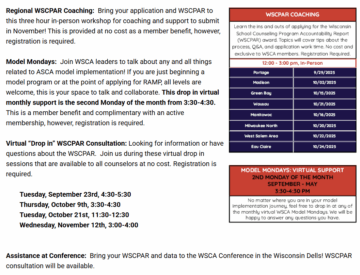
Let’s make this the year your program gets the recognition it deserves. Your students’ success is worth celebrating, and the WSCPAR is the perfect tool to showcase it. We can’t wait to see your submission by November 24th! 

Cindy Bourget
WSCA Data & WSCPAR Director
ASCA Connections

Federal Grants Update

On August 15, ASCA submitted formal comments to the U.S. Department of Education in response to proposed changes to two federal initiatives: the Mental Health Service Professional Demonstration Grant Program (MHSP) and the School-Based Mental Health Services Grant Program (SBMH).

In its response to the MHSP proposal, ASCA emphasized the need for local education agencies (LEAs) to retain flexibility in how they use grant funds to address school-based mental health workforce shortages. ASCA urged the Department to revise the eligibility criteria to include school counselors, social workers, and other qualified professionals, rather than limiting participation to school psychologists. ASCA also advocated for allowing Institutes of Higher Education (IHEs) to serve as lead applicants, citing their essential role in preparing and placing school-based mental health professionals, particularly in rural communities.

Additionally, ASCA raised concerns about the proposed requirement for explicit written consent, recommending more practical replace opt-out with passive consent policies that reflect school settings and allow for timely intervention. The association further called for the program’s scope to be broadened to include universal prevention and Tier 1 supports, ensuring that all students, not just those in replace crisis with intensive services, benefit from school-based mental health services.

In its comments on the SBMH grant program, ASCA expressed concern that the proposed rule similarly restricts eligibility to school psychologists, excluding school counselors and school social workers who are vital to meeting student needs. ASCA recommended adopting the broader definition of “school-based mental health services provider” found in the Every Student Succeeds Act. ASCA also highlighted the importance of addressing high student-to-counselor ratios, which remain well above the recommended 1:250 in many states and called for grant funds to support efforts to meet these benchmarks.

ASCA urged the Department to expand the program’s re-specialization priority to include all school-based mental health professionals and to support streamlined licensure pathways and improved reciprocity policies across states. As with the MHSP program, ASCA raised concerns about the proposed consent requirements and recommended language that balances parental rights with timely access to services. Finally, ASCA called for a broader scope that includes universal prevention and early intervention, arguing that a narrow focus on intensive clinical services would exclude the majority of students and limit the program’s overall impact.

ASCA Toolkits & Resources

ASCA Out and About

Quoted in EdSurge article,  Are High School Counselors Encouraging AI for College Applications?

Feature Article

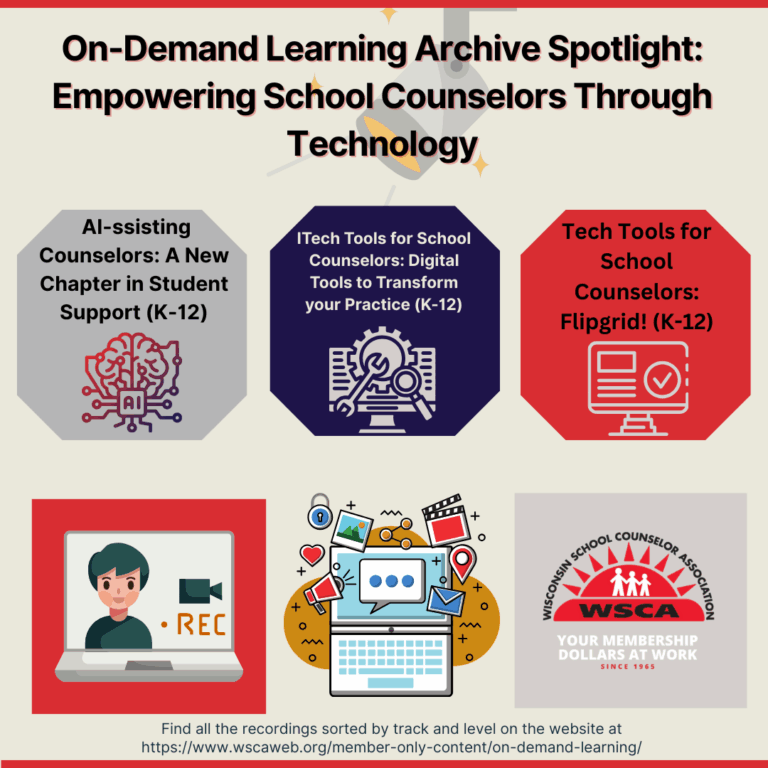
AI in Education: What School Counselors Need to Know

By: Stacy Eslick, Executive Director, Wisconsin School Counselor Association


Artificial intelligence (AI) is becoming a common feature in schools, offering new ways to save time and support learning. For school counselors, these tools can seem both exciting and uncertain. AI platforms can assist in drafting communications, summarizing lengthy reports, or generating ideas for classroom counseling lessons, but they also raise important questions about ethics, law, and professional responsibility. According to the ASCA Ethical Standards for School Counselors, counselors are expected to protect confidentiality, follow federal and state laws, and ensure that the technology they use provides adequate security for student data.

Advantages for Counselors

Used thoughtfully, these tools can:

  • Save time on routine paperwork.
  • Provide drafts of parent or staff communications.
  • Suggest creative lesson ideas or resource lists.
  • Make documents more accessible.

Even chatbots, AI that simulates conversation, are being explored in schools to answer general FAQs like “When is the scholarship deadline?” or “What is the character trait of the month?” These can extend counselor communication, but only when limited to non-confidential information.

Risks and Ethical Concerns

What problem am I trying to solve with AI? Does this tool truly support my counseling goals and not detract from the critical relational aspects of school counseling? Framing AI use around purpose ensures it adds value to communication, efficiency, or resource sharing, without compromising ethics, confidentiality, or student trust. 

With advantages come significant cautions:

  • Confidentiality & Student Records: FERPA protects student information. Uploading personally identifiable information into external AI tools could be a violation . Counselors should never use AI to draft or edit legal documents such as IEPs or 504 Plans, which require strict compliance with law and district processes .
  • Accuracy & Bias: AI content can be inaccurate or biased. Counselors are responsible for reviewing outputs critically and ensuring they align with professional standards.
  • Intellectual Property: Uploading counselor-created lessons or data projects into AI tools may unintentionally give away usage rights. Likewise, sharing copyright-protected curriculum can violate licensing agreements. Counselors must protect both their own work and purchased materials.
  • Policy Alignment: ASCA emphasizes that counselors must “know and apply the laws, rights, and policies” governing the use of technology. That means checking with administrators before adopting AI in professional practice.

Popular AI Tools for School Counselors

  • ChatGPT (OpenAI): A versatile AI resource that can generate text and answer questions. Counselors might use it to polish parent letters, generate NSCW ideas, brainstorm newsletter topics, or develop questions for career readiness lessons. It’s a flexible “idea starter” but requires careful review for accuracy and appropriateness. May generate inaccurate info or biased text.
  • NotebookLM (Google): Summarizes and organizes uploaded documents, helpful for processing long reports or creating study notes. For counselors, it can make professional learning more manageable by condensing policy updates, district reports, or research articles into clear takeaways. It’s a way to quickly pull meaning from information-heavy documents. Uploading confidential or copyrighted documents could create compliance issues. 
  • SchoolAI: Designed with schools in mind, this platform includes communication supports, student engagement prompts, and templates. For counselors, it can streamline everyday tasks like drafting announcements, creating advisory activity outlines, or preparing presentations for families and staff. Content may not be developmentally appropriate unless reviewed.
  • Magic School AI: Tailored specifically for educators, Magic School offers hundreds of templates. Counselors can use it to generate classroom counseling lessons, adapt resources for different developmental levels, or draft exit tickets for counseling activities. It also offers tools to help brainstorm ideas for student support plans. Still, counselors must remember not to input student-identifiable data or become overly reliant on AI to meet the individualized needs of students.
  • Brisk: Integrates into Google Docs and adapts documents to different reading levels, translates information into multiple languages, and provides quick editing assistance. This makes it especially useful for ensuring parent communication, event flyers, or resource guides are accessible to all families and community partners. Uploading curriculum or copyrighted content may violate licensing; ensure translations are accurate.

Conclusion

AI resources, such as ChatGPT, NotebookLM, SchoolAI, Magic School AI, and Brisk, can help school counselors save time and spark new ideas. However, with these opportunities come clear responsibilities: safeguarding student privacy, avoiding the use of AI for legal or confidential documents, protecting intellectual property, and adhering to district and state policies. By applying professional judgment and leaning on ASCA’s ethical framework, counselors can explore AI thoughtfully, ensuring it supports, rather than compromises, the integrity of their work.

References

This article was produced with drafting support from ChatGPT.

DPI Connections

Reminder: Academic and Career Planning Statutory Requirements for Districts

As part of Wisconsin’s Education for Employment (E4E) statute, all school districts must post the current, board-reviewed Academic and Career Planning/E4E plan on the district website.

In addition to posting the current plan, school districts must:

  • Annually review and, if needed, update the long-range ACP/E4E plan based on student postsecondary outcomes.
  • Publish an annual report on the E4E program’s progress and goals.
  • Include on student transcripts course titles, credits earned, postsecondary credit eligibility, and any partner institutions.
  • Notify parents and families annually about the ACP/E4E program and available opportunities, including the availability of programs at technical colleges.

You can learn more about the specific requirements for school districts in Wisconsin’s Guide to Publishing your District’s ACP/E4E Plan.  Please contact the DPI’s Education Consultant Karin Smith at Karin.Smith@dpi.wi.gov if you have any questions.

Herb Kohl Educational Foundation Teacher Fellowship

Nominations are now being accepted for the 2026 Herb Kohl Educational Foundation Teacher Fellowship (this includes school counselors!) and Principal Leadership awards, honoring exceptional Wisconsin PK–12 educators and school leaders. Each award recipient receives $6,000, and their school will also receive a matching $6,000 grant. Teacher nomination deadline: 5 p.m. on Tuesday, Nov. 11, 2025. Nominations can be submitted online at KohlEducation.org.

The DPI is Evolving to Serve You Better

The Wisconsin Department of Public Instruction recently adopted a new organizational structure designed to strengthen how we support you. This reorganization is part of our broader strategic plan and was shaped by feedback from statewide listening sessions. It reflects our commitment to being more responsive, effective, and aligned in all the things we do.

DPI staff are now organized into more connected divisions, offices, bureaus and sections — reducing silos, improving coordination, and delivering streamlined service. You will still work with the same DPI experts you know and trust, but we’re better connected internally to get you the answers, guidance and resources you need faster.

We’re excited to move forward with you as a partner in this new chapter. Learn more about what’s changing and what it means for you on our website.

Updated Public Report Card App Now Available

As part of the Wisconsin Department of Public Instruction’s ongoing efforts to modernize tools and improve user experience, an updated version of the public report card application is now available. This updated application maintains the same core features as the previous app, such as downloading PDF report cards for every school and district by school year. New features include the ability to search by school or city and download multiple report cards at once, and an updated interface. Check it out here.

You Spoke, We Listened

Legislative Updates

Be the Voice. Lead the Change.

NEW! WSCA Virtual Regional Advocacy Listening Sessions

As school counselors, you advocate fiercely for your students every day, but advocating for your role, your program, and the policies that shape our schools can feel daunting. That’s where WSCA’s Advocacy & Government Relations Committee comes in!

This year, we’re bringing advocacy directly to you with virtual listening sessions in every CESA region. These one-hour conversations are your chance to share what’s happening in your schools, connect with counselors across the state, and shape the advocacy resources WSCA will create to strengthen our profession.

Why attend?

  • Connect with fellow counselors who want to be agents of change at the school, district, and state levels.
  • Learn how to combine data and your powerful stories to elevate your program.
  • Explore how to bring ASCA’s recommendations into conversations with administrators, school boards, and legislators.
  • Ensure your voice is heard as WSCA builds the next wave of advocacy tools.

Mark your calendar! Virtual sessions kick off this December and run through March, every Wednesday from 4:00–5:00 pm.

  • December: Dec 3-CESA 12 • Dec 10- CESA 11 • Dec 17-CESA 10
  • January: Jan 7-CESA 9 • Jan 14-CESA 8 • Jan 21-CESA 7 • Jan 28-CESA 6
  • February: Feb 11-CESA 5 • Feb 18-CESA 4 • Feb 25-CESA 3
  • March: Mar 4-CESA 2 • Mar 11-CESA 1

Don’t miss this chance to add your voice, strengthen our collective message, and help shape the future of school counseling in Wisconsin.

2025-2026 Professional Development

Tiered Professional Support

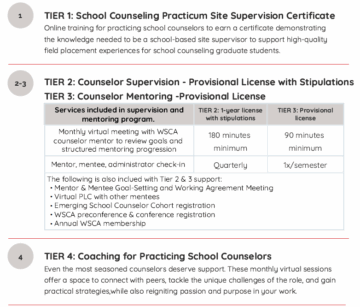
WSCA offers opportunities for school counselors to receive training, supervision, mentoring, and coaching support through all stages of their careers. Full or half-year options are available for Tiers 2-4. The role of a school counselor can be demanding and emotionally taxing. Access to tiered support provides counselors a structured program to discuss challenges, seek advice, and receive reassurance. This is crucial for preventing burnout and job dissatisfaction, regardless of the number of years in the field. Learn more on the Tiered Professional Support webpage.

2025-2026 ASCA Model Updates & Training

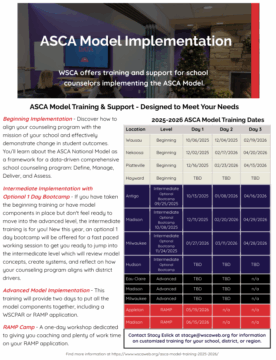
WSCA is traveling the state again to provide in-person ASCA model updates and training!  Check out all the opportunities below and register on the ASCA Model Training webpage.
Members Corner